
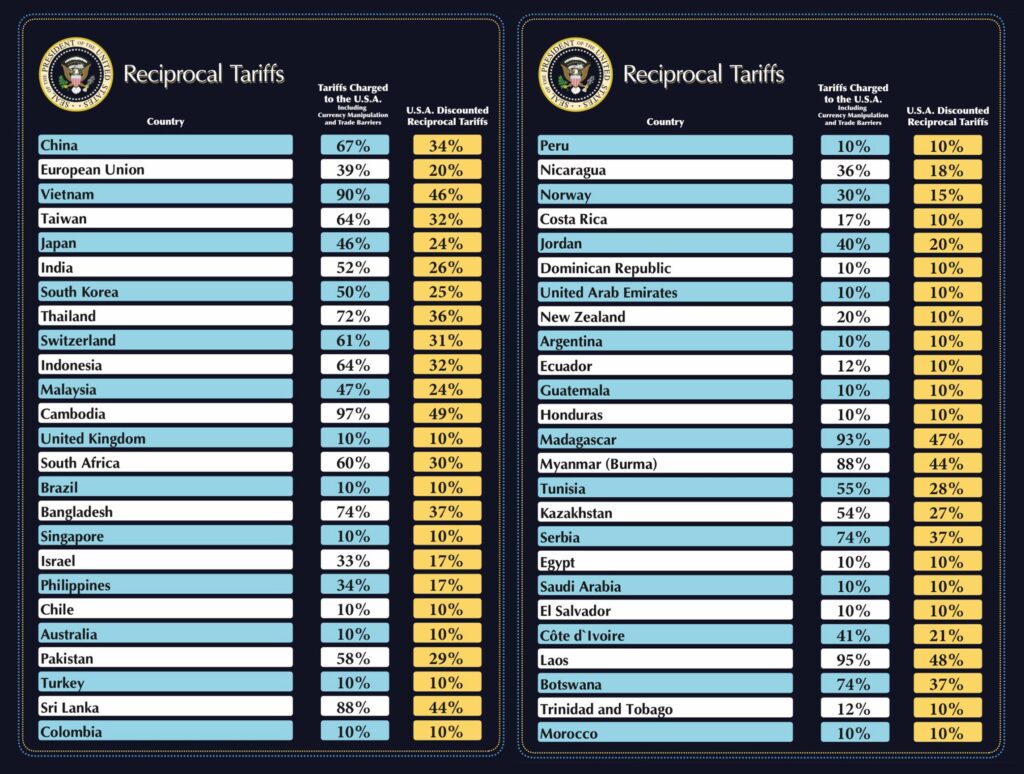
List of President Trump’s “Reciprocal Tariffs.”
Imported goods from across the globe will soon become more expensive following the announced imposition of tariffs upon the countries manufacturing those imports. On April 2, 2025, President Trump revealed that the United States is scheduled to impose a 10% tariff on imports from all countries, and for several countries, the rate will be significantly higher. The new tariff rates levied against China and Vietnam, for example, are 34% and 46%, respectively. The White House’s announcement can be found here. These new tariffs relative to specific countries are scheduled to go into effect on April 9, 2025. Touted by President Trump as “Liberation Day,” April 2, 2025, is a day that is certainly to be remembered, but is it the death knell to the yachting industry as some purchasers and brokers have been led to believe?
No, probably not.
By way of background, when a good is built outside of the United States and is thereafter shipped to the United States for use or consumption in the United States, import duty must be paid unless an exemption applies. Generally speaking, an import duty is like a tax that is imposed on specific types of goods (e.g., steel, lumber, soybeans, automobiles) regardless of their country of origin. For some goods, however, duty is exempt due to free trade agreements between the United States and the country that manufactured those goods. Duty rates can be ad valorem—a percentage of the good’s value—or they can be a specified amount. Similar to duties, tariffs are often imposed on goods based on the country in which the goods were manufactured, and the cost of the tariff is in addition to the ad valorem duty rate. Together, duties and tariffs both increase the cost to import a good.
When it comes to vessels, duty is assessed ad valorem, and the typical import duty rate is 1.5% of the value of the vessel. It is no secret that many pleasure vessels are built overseas, e.g., France and Italy, loaded onto a cargo ship, and then offloaded in the United States for use by United States Citizens in United States waters. Accordingly, in addition to any State excise tax that might be due, those purchasing vessels built overseas must typically pay 1.5% of the vessel’s value to import the vessel into the United States. With a relatively low percentage that equates to $1,500.00 of duty for every $100,000.00 of the vessel’s purchase price, the cost of the import duty is often a relatively small cost for the purchaser to pay. But not every vessel is treated the same when it comes to the cost of importation. For purchasers of vessels that were manufactured in China, which was and is subject to steep tariffs, the cost to import is not merely the typical 1.5% duty, as the cost to import was increased to 25% of the vessel’s value due to tariffs. Now that the Trump administration has begun to increase tariffs across the board, the rate to import all vessels is going to be significantly higher. While we are waiting for clarity in the form of the final executive order and new published tariff rates, it appears at this point that a number of foreign-built vessels which previously enjoyed a relatively low duty rate and no tariff, will now have a tariff in the range of 20-50% levied on them. In light of these increased costs, many purchasers and yacht brokers have begun to question whether the purchase of foreign-manufactured vessels is still viable. The answer is yes.
Naturally, those willing to stomach the increased duties to acquire the vessel of their dreams are free to open their pocketbook. Most other purchasers, and specifically, those who cannot afford to pay an additional 20%, 30%, or even 50% on top of the vessel’s purchase price, will need to look for an alternative solution. True, several big brands have production facilities in the United States, and the vessels produced from those facilities will be exempt from the increased duties as they do not need to be imported. But what is a purchaser to do if their vessel of choice is not manufactured domestically? The answer is to place the vessel in another registry. Colloquially referred to as “offshore flagging” or “flags of convenience”, when done correctly, not only can placing a vessel in an offshore registry exempt the vessel from import duty altogether, it can also exempt it from State excise tax.
Generally speaking, the choice of whether to offshore flag comes down to the numbers, i.e., is it more expensive to pay import duty and State excise tax than it is to offshore flag? If the answer is “yes”, then offshore flagging can be a viable way to save money. Placing a vessel in an offshore registry is significantly more expensive than paying the nominal fees required to document a vessel with the United States Coast Guard. Indeed, depending on the offshore registry, fees can range from a few thousand dollars to tens of thousands of dollars. Despite these higher costs, in certain instances, the costs of import duty and State excise tax can still far outweigh the upfront and carrying costs of an offshore registration. For example, Florida’s State excise tax is 6% of the value of the vessel, and it is capped at $18,000.00. Similarly, Maryland’s State excise tax is 5% of the value of the vessel, and it is currently capped at $15,900.00 and increases by $100 each year. But other States tax vessels at a higher rate and do not provide a cap, which can lead to a significant tax bill. Massachusetts, for example, imposes an uncapped tax of 6.25%, so a vessel worth $1,000,000.00 would be subject to a $62,500.00 State tax bill, in addition to the 1.5%, $15,000.00 import duty. When State excise tax is not a concern, and with an ad valorem duty rate of only 1.5%, the amount of the traditional import duty—standing alone—infrequently justifies the expense of offshore flagging. When the duty rate, coupled with the newly-announced tariffs, increases to 10-50% or more of the vessel’s value, however, the expense of offshore flagging is almost always cheaper than the amount of the import duty.
As with everything, there are other pros and cons to offshore flagging. Attorneys at Lochner Law Firm, P.C., are experienced with the various facets of offshore vessel registration and can help you decide if offshore registration is the right fit for you and your clients.